Skip to content
Body Type Calculator

Male Body Shape Calculator

Find your body type as a man from four tape measurements — shoulders, chest, waist and hips. You get your shape and a clear explanation of the ratios behind it.

Enter your measurements

Measurement unit

Around the widest part of the shoulders, arms relaxed at your sides.

Around the fullest part of the chest, just under the armpits.

Around the narrowest part of the torso, or at the belly button.

Around the fullest part of the hips and seat, feet together.

Accepted range: 16–79 in. Decimals are fine.

Calculated in your browser. Your measurements are not sent anywhere or saved, and no account is needed.

Measuring for a woman? Use the female body shape calculator.

The five male body types

Male body shapes mostly differ in how much the shoulders taper to the waist, and whether the hips or waist are the widest part. No shape is better than another.

How the male body shape calculator works

The calculator turns your four measurements into ratios, checks the rules below in order and returns the first match. Using ratios means the rules work the same in inches and centimeters, and your overall size doesn’t affect the result. It also checks whether a change of about 1 in (2.5 cm) in any one measurement would give a different shape.

About these thresholds: unlike women’s body shapes, there is no single widely used research system for sorting male shapes from tape measurements. These ratios are this site’s own simplified rules, shown in full so you can check any result by hand. They describe proportions only and are not medical or fitness standards.

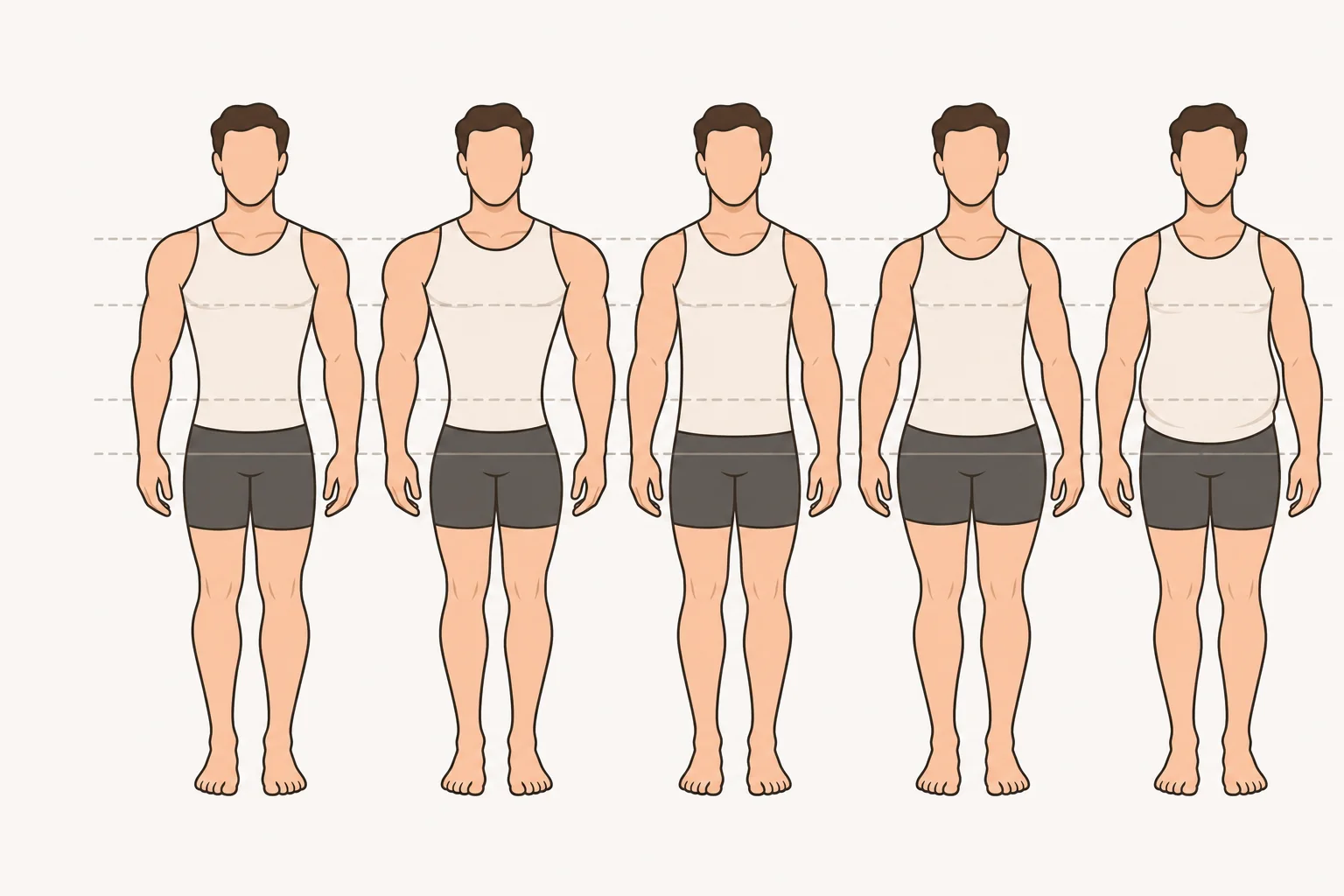
Five men of the same height standing side by side, from left to right: trapezoid, inverted triangle, rectangle, triangle and oval body shapes, with dashed lines marking shoulder, chest, waist and hip level.
The five male shapes at the same height. The dashed lines mark shoulder, chest, waist and hip level, from top to bottom.
Male body shape rules, checked in order
OrderResultRule
11. OvalWaist is at least 95% of both the chest and the hips.
22. TriangleHips are at least 105% of the chest.
33. Inverted TriangleShoulders are at least 1.45× the waist.
44. TrapezoidShoulders are at least 1.30× the waist (but under 1.45×).
55. RectangleNone of the above: little taper, and waist and hips not the widest part.

Male body shapes explained

Trapezoid body shape (male)

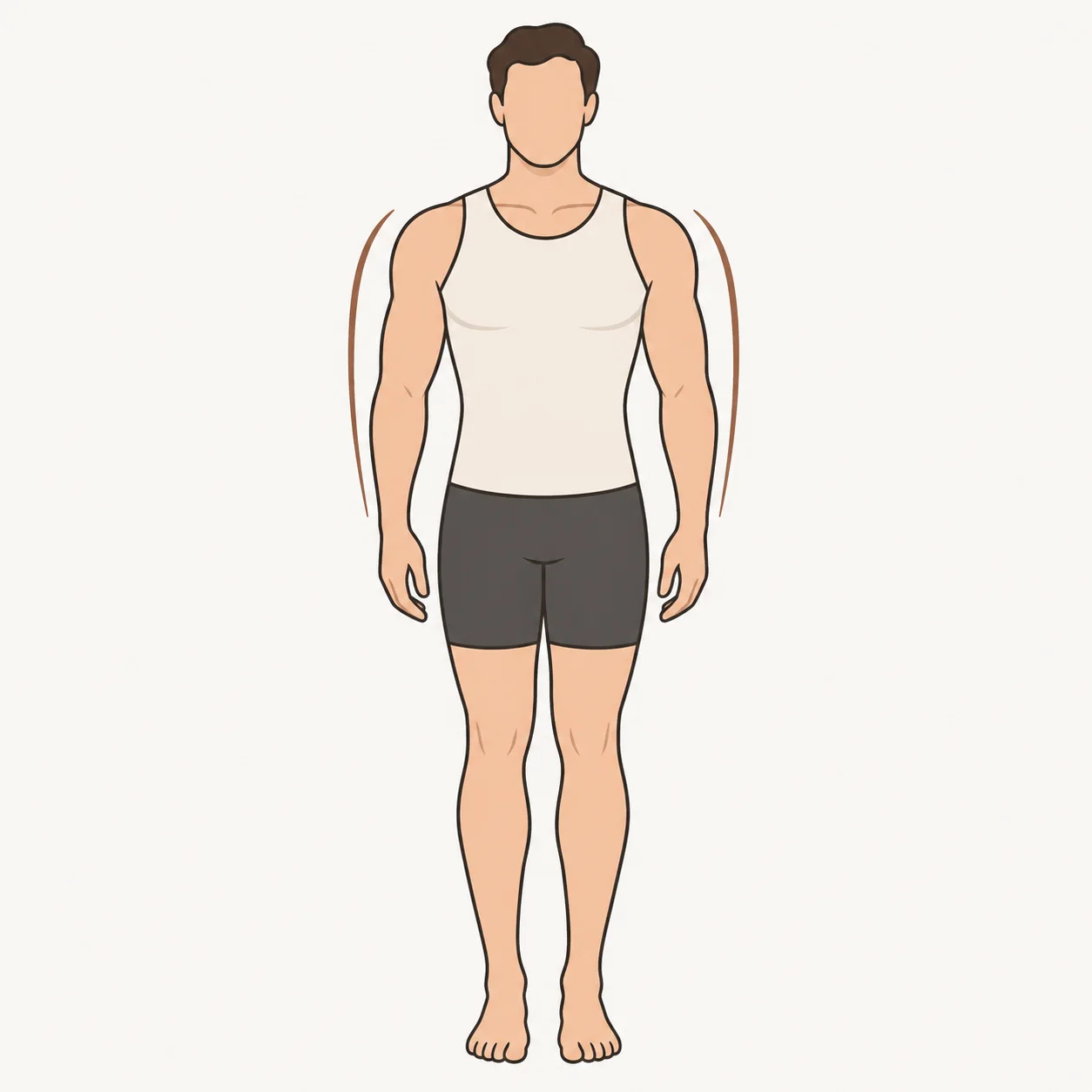
The trapezoid sits between rectangle and inverted triangle. The shoulders are noticeably wider than the waist, but the difference is not as pronounced as in an inverted triangle, and the hips are not wider than the chest.

Rule: 1.30 ≤ shoulders ÷ waist < 1.45, and not Oval or Triangle

Example: shoulders 48 in, chest 42 in, waist 35 in, hips 39 in → Trapezoid

  • Often described as a balanced or “classic” frame in menswear guides — a description, not a ranking.
  • Standard off-the-rack shirts and jackets are usually cut for roughly this taper.
  • A small change in the waist measurement can move the result to rectangle or inverted triangle.
Inverted Triangle body shape (male)

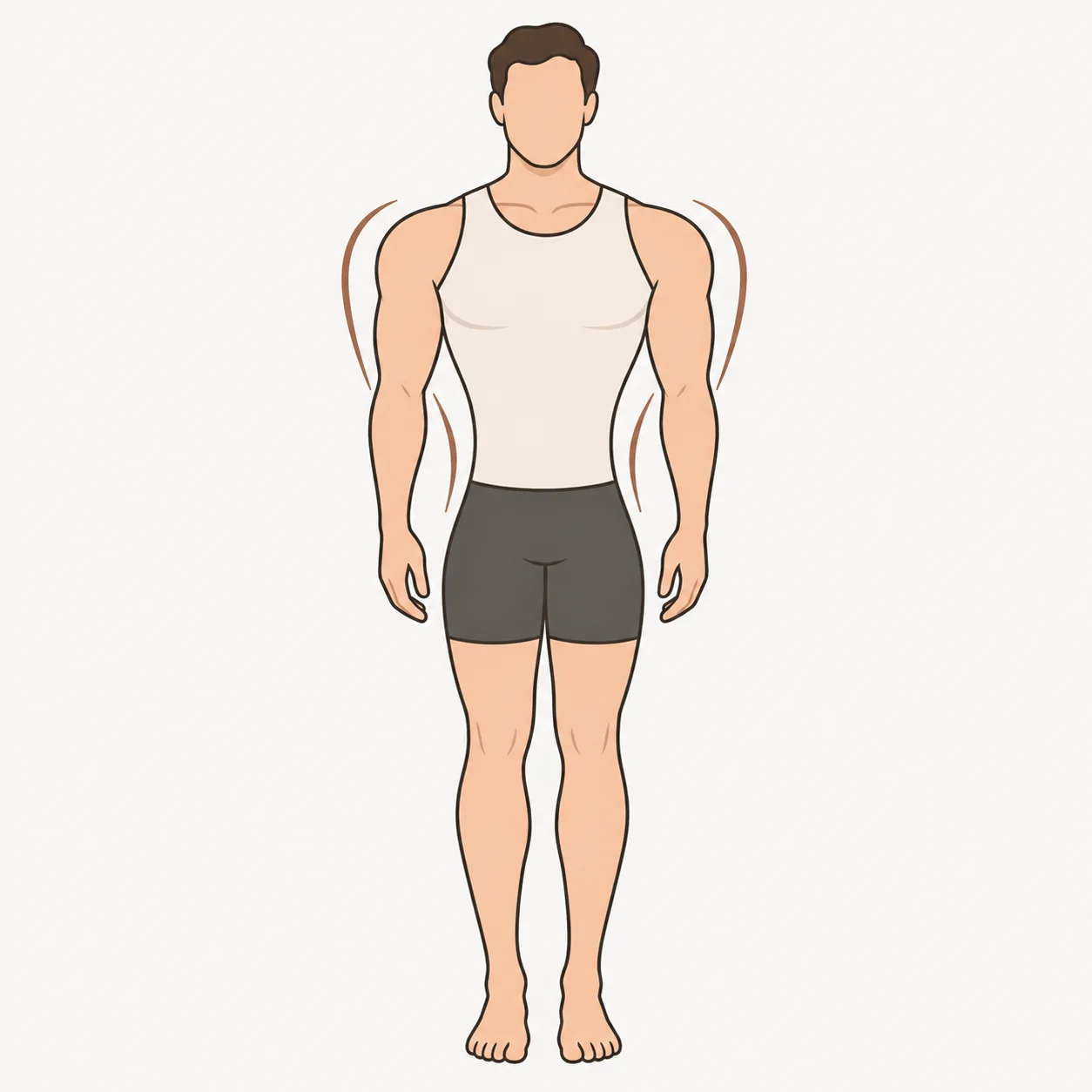
An inverted triangle has the largest shoulder-to-waist difference of the five shapes. The shoulders and chest are the widest part of the body, and the waist and hips are comparatively narrow.

Rule: shoulders ÷ waist ≥ 1.45, and not Oval or Triangle

Example: shoulders 52 in, chest 44 in, waist 34 in, hips 38 in → Inverted Triangle

  • Can come from a broad skeletal frame, upper-body muscle, or both.
  • Shirts that fit the shoulders are often loose at the waist; tailored or athletic cuts address this.
  • Shoulder circumference is the hardest measurement to take accurately alone, so re-measure if you are near the threshold.

Rectangle body shape (male)

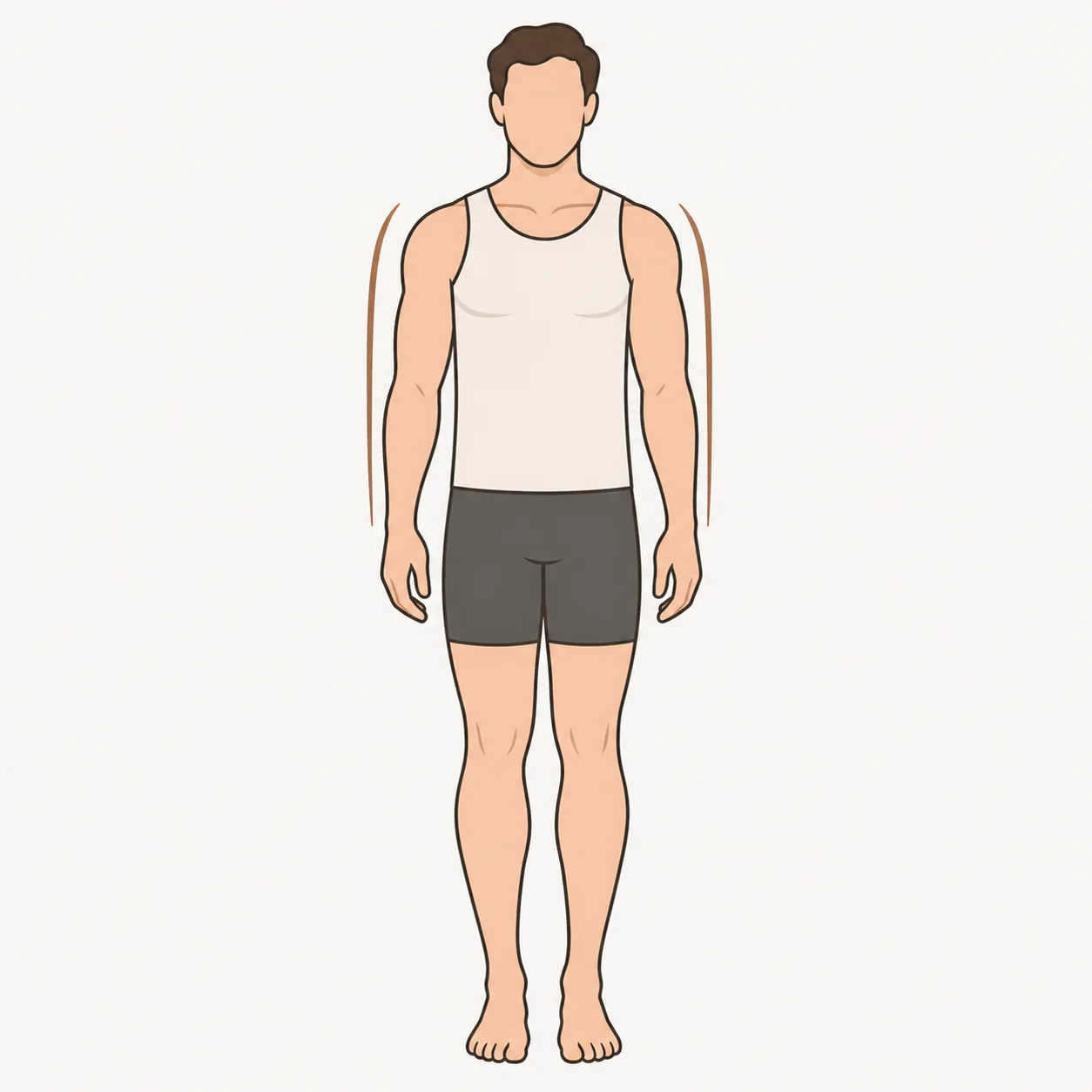
A rectangle has little taper from shoulders to waist. The waist is still smaller than the chest, but not by much, and the hips are not noticeably wider than the chest.

Rule: shoulders ÷ waist < 1.30, and not Oval or Triangle

Example: shoulders 46 in, chest 40 in, waist 37 in, hips 39 in → Rectangle

  • One of the most common results, covering a wide range of builds and sizes.
  • Straight-cut shirts and trousers often fit well without much tailoring.
  • Not a measure of muscle or fitness — lean and heavier builds can both be rectangles.

Triangle body shape (male)

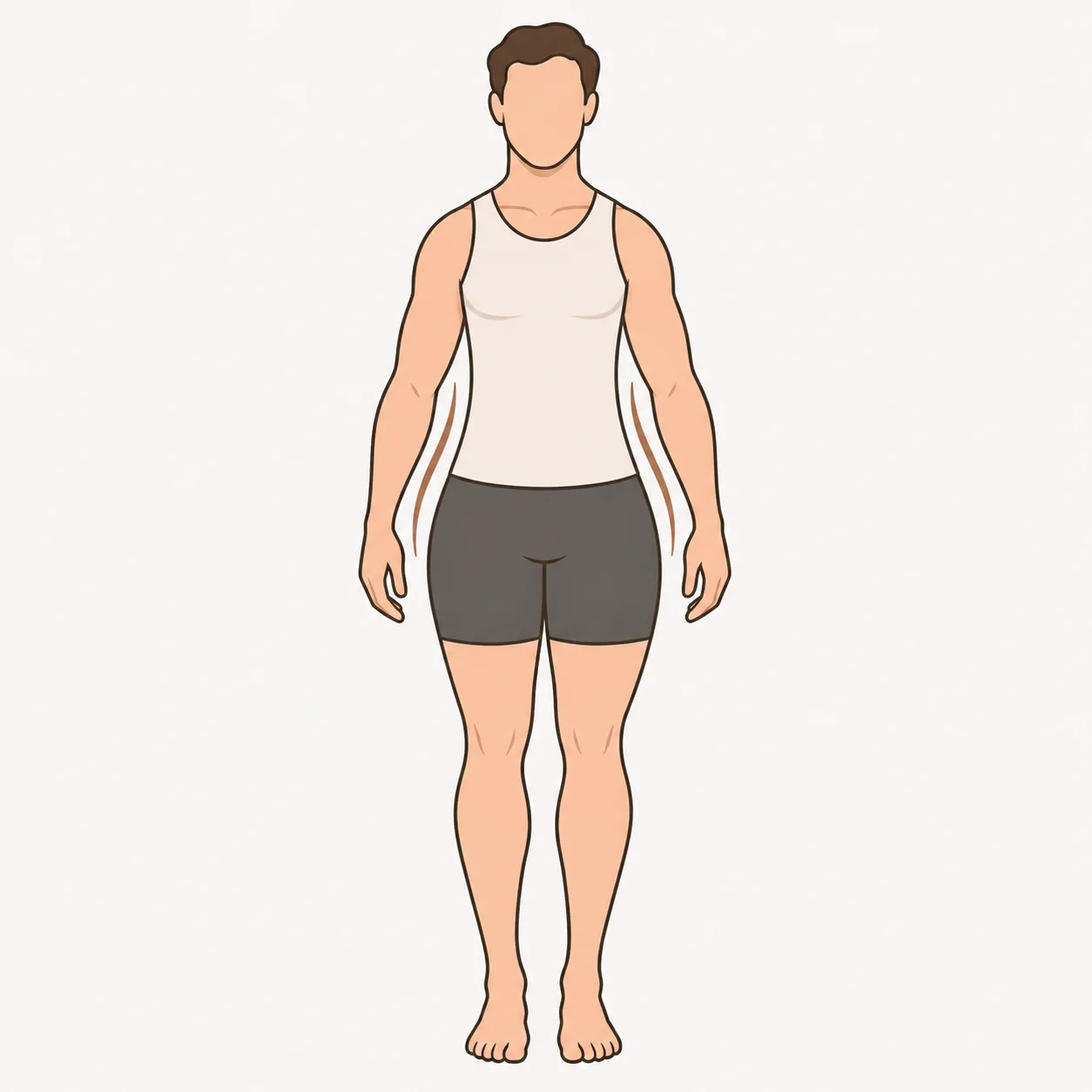
In a triangle shape the hips measure more than the chest, and the shoulders are comparatively narrow. Some guides call this a pear or “A-frame” shape.

Rule: hips ÷ chest ≥ 1.05, and not Oval

Example: shoulders 44 in, chest 38 in, waist 35 in, hips 41 in → Triangle

  • Less common in men than in women, but it occurs across all sizes.
  • Trousers that fit the hips and seat may be loose at the waist.
  • Measure the hips at the fullest part of the seat — measuring too high is a common cause of a different result.

Oval body shape (male)

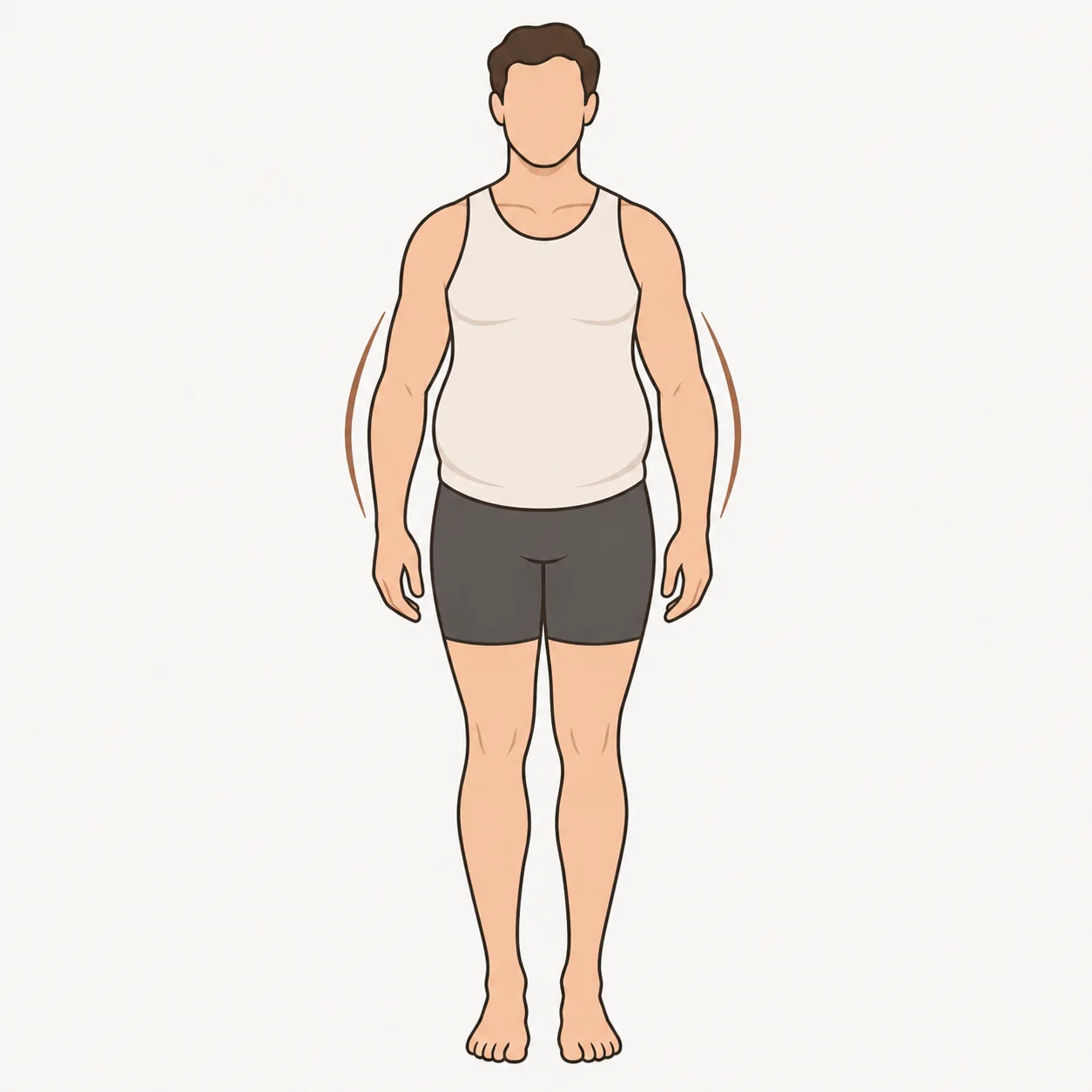
An oval shape has the midsection as the widest or nearly the widest part of the torso. Shoulders and hips are usually narrower than the waist. Some guides call this a round or “apple” shape.

Rule: waist ÷ chest ≥ 0.95 AND waist ÷ hips ≥ 0.95

Example: shoulders 48 in, chest 44 in, waist 44 in, hips 43 in → Oval

  • A neutral description of proportions — it is not a health assessment.
  • Waist measurements change through the day, so measure at a similar time if you compare results.
  • Shirts and jackets with more room through the middle usually fit more comfortably.

How to measure your body shape as a man

Use a flexible tape, stand relaxed with your feet together, and keep the tape level and snug without pulling it tight. Taking each measurement twice helps. The general measuring guide covers tape technique and common mistakes in more detail.

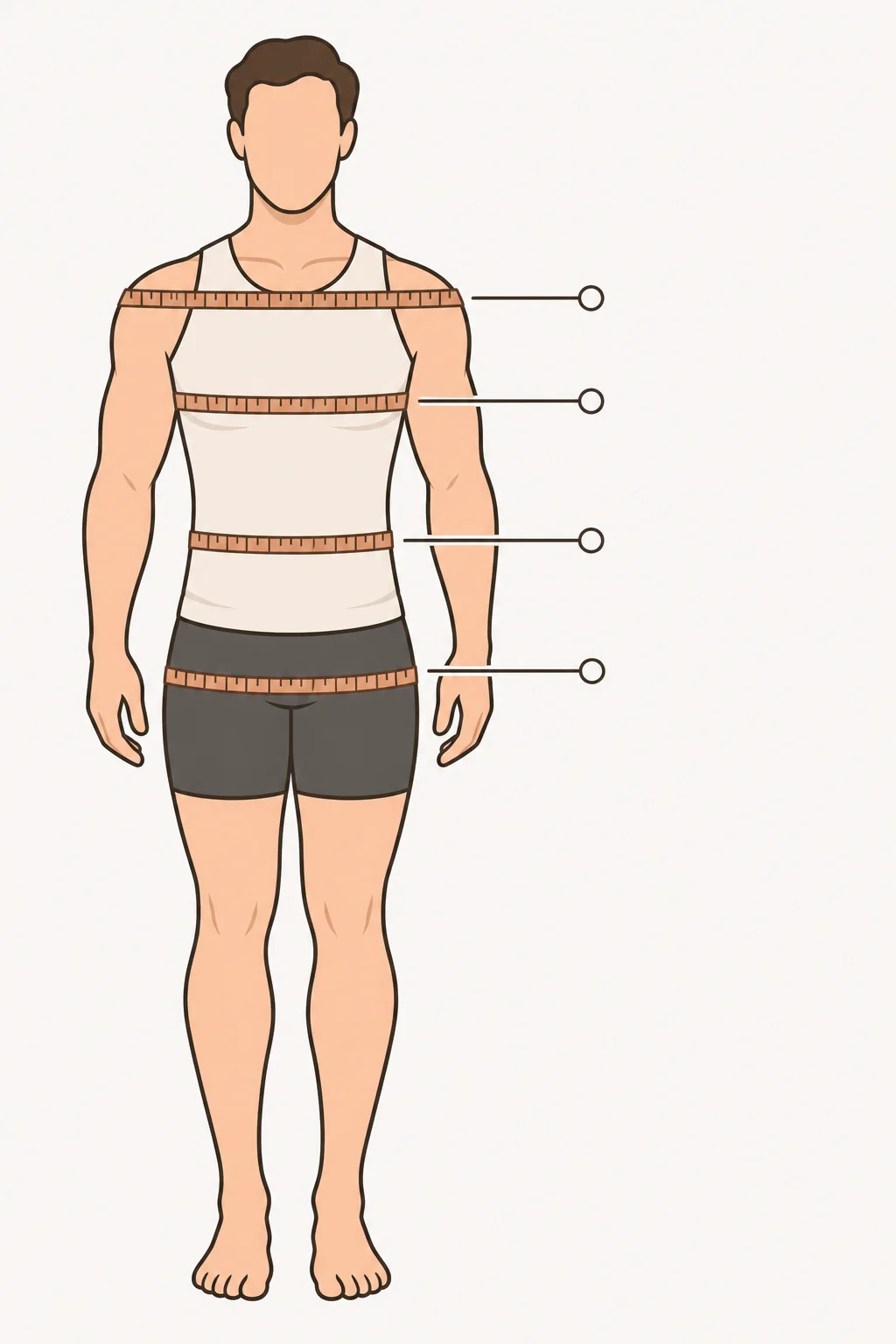
Illustration of a man standing with four measuring tapes: around the shoulders, the chest just under the armpits, the waist at belly-button level, and the fullest part of the hips.
  1. 1

    Shoulders

    Stand with your arms relaxed at your sides. Wrap the tape around the widest part of your shoulders and upper arms, level all the way around. This is easiest with a helper.

  2. 2

    Chest

    Lift your arms, place the tape just under your armpits around the fullest part of your chest, then lower your arms. Breathe normally.

  3. 3

    Waist

    Measure around the narrowest part of your torso. If there is no clear narrowest point, measure at the level of your belly button. Don’t hold your stomach in.

  4. 4

    Hips

    With your feet together, measure around the fullest part of your hips and seat, keeping the tape parallel to the floor.

Male body shape calculator FAQ

How does the male body shape calculator work?

It compares four measurements as ratios: shoulders to waist (how much your upper body tapers), hips to chest (whether your lower body is wider), and waist to chest and hips (whether your midsection is the widest part). The ratios map to one of five shapes.

What are the male body types?

This calculator uses five: trapezoid, inverted triangle, rectangle, triangle and oval. Other guides sometimes use different names, such as V-shape for inverted triangle or round for oval.

Why does it need a shoulder measurement?

Shoulder width is the main thing that separates trapezoid, inverted triangle and rectangle shapes in men. Without it, the calculator could not tell a strong taper from a straight frame.

Is there an ideal shoulder-to-waist ratio?

No. Some fitness content promotes a “golden ratio” of around 1.6, but that is an aesthetic idea, not a health or medical standard. The ratio here only describes your proportions.

Are these thresholds scientifically established?

No. There is no single, widely used research standard for male body shapes from tape measurements. The thresholds are this site’s own simplified rules, published so you can check them, and other tools may classify you differently.

Is male body shape the same as ectomorph, mesomorph or endomorph?

No. Those somatotypes describe overall build — lean, muscular or rounded. Body shape describes the proportions between shoulders, chest, waist and hips.

Can women use this calculator?

The categories are designed around male proportions. For women, the female body shape calculator uses bust, waist and hips with categories designed for female figures.

Looking for women’s shapes such as hourglass and pear? See the body shape types guide, or read the full body shape FAQ.

Use your result as a starting point

Your shape is a quick way to describe your proportions when comparing shirt and jacket fits or size charts. It is not a measure of health or fitness. If you were close to a boundary, read both shape descriptions.

Cookie settings

Choose which optional categories you allow. You can change this at any time from “Cookie Settings” in the footer.